
1/2 ”My father had heard that men and women got separated at the UN base. All the male family members tried to escape through the woods. Still, my father didn’t want to leave my mother alone. My mother was pregnant at the time, and I was only three years old. Together, we arrived at the UN base in Potočari. My mother tried to convince my father to dress up like a woman so they wouldn’t capture him. He refused to do that. When the buses, for evacuating women and children, arrived they wouldn’t let my father get on. He was hoping that the soldiers would show him some compassion as he was carrying me. But they told him to go and stand with the other men, and to give me to anyone else or they would kill me. He gave me to my mom, who was standing nearby, and told her to take good care of us and that they would see each other soon.”
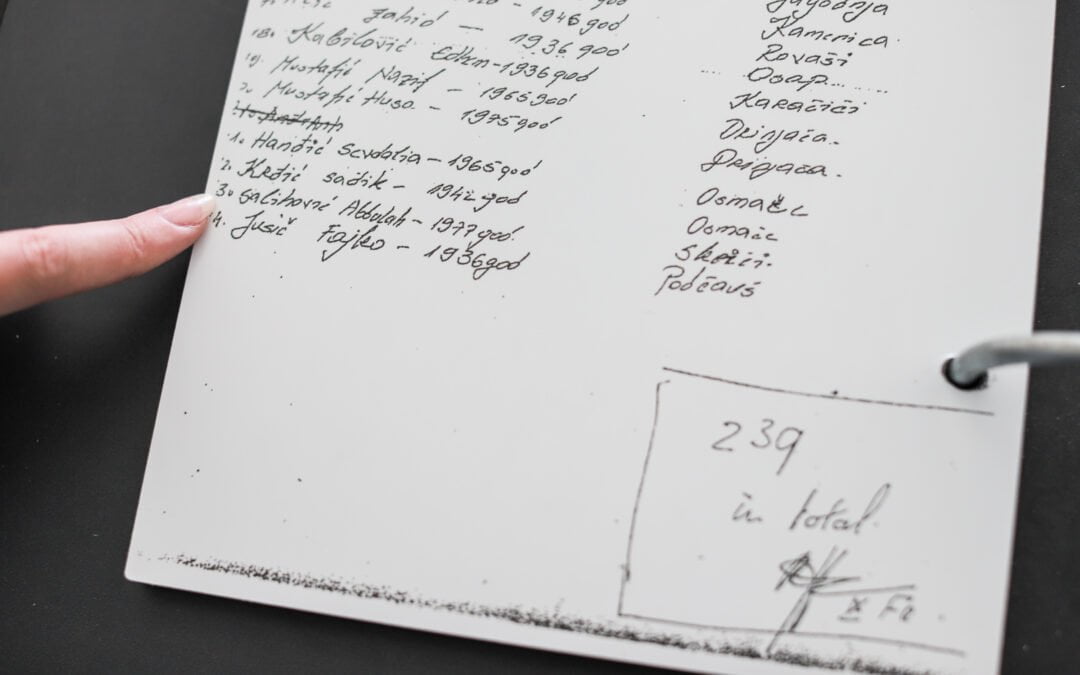
5/5 ‘’In February 2020 I went to the old factory, which is now a museum, as a translator with a group of students. While the students were going through the museum, I sat down. On the table, there was a file with some documents. I randomly scrolled through the pages, and I saw it was a list of names. When I turned to the last page, I saw the second-last name on the list. It was my brother’s full name and year of birth: SalihovicAbdulah – 1977.”
4/5 ”In 2008, I received a phone call that Abdulah’s body had been found. Thirty percent of his remains were found in a town called Zvornik. They made a reconstruction and told us that Abdulah had been shot. We had been waiting for so many years that we decided to bury him and not to wait until the rest of his remains were found. In 2010, my uncle Redzo was found, and we buried him next to Abdulah. Fatima never spoke of what happened until earlier this year, when she wrote me a letter in which she described her memories. In the letter, she explains that in the factory, Dutch soldiers went around with a piece of paper, asking every boy older than 15 to write down his name. Fatima and Abdulah were debating whether or not it was a good idea to write down his name. He was the second-last person to write down his name. On the list, there were 239 names of boys and men. A Dutch commander signed the list. When they got out of the factory, these boys and men were separated from the others, and they had to stay. Fatima describes getting on the bus and looking Abdulah in the eyes one last time. They both knew he was going to die. She says that she still can’t forgive herself for not doing anything. In February 2020 I went to the old factory, which is now a museum, as a translator with a group of students. While the students were going through the museum, I sat down. On the table, there was a file with some documents. I randomly scrolled through the pages, and I saw it was a list of names. When I turned to the last page, I saw the second-last name on the list. It was my brother’s full name and year of birth: SalihovicAbdulah – 1977.”
3/5 “On our way to Tuzla, people on the side of the road cursed and threw stones at us. After driving for an hour, the bus stopped. A Serbian soldier came on board. I remember how big he was. He was wearing military pants, and he had no shirt on. He had a knife in one hand and in the other hand, he held a gun. He cursed and screamed at us. He ordered us to give him our jewelry, gold, silver, or money. Nobody had anything. As nobody had anything to offer him, he became angrier. You could feel the fear inside the bus. Next thing I remember, I stood up. I didn’t have any feeling in my legs. At the time, I had a doll with just one eye. I was shaking, and I said: “please take my doll”. It was my most prized possession. Everyone on the bus was silent and looking at me. The next moment, the bus driver intervened. He told the soldier to leave, and he left. We arrived in Tuzla, and stayed in a refugee camp. Not long after we arrived, my eldest sister Fatima finally joined us. She was alone. My mother asked her: ‘Where is Abdulah?’ Fatima said: ‘The Serbian Army captured Abdulah.’ My mother fainted. We allscreamedandcried.”
2/5 ”From 8th to 11th of July 1995 the city of Srebrenica was under final attacks by the Bosnian-Serb army. On 11th of July we went to the old battery factory, which was the Dutch UN base in Potocari, to find protection. My mother walked with the four youngest children, including me. My older sister Fatima, who was nineteen, and my brother Abdulah, who was seventeen, walked together. Because there were so many of us, we decided it would be easier to split up and meet each other at the factory. That day, my mom was wearing traditional clothes. I remember holding on tight to her dress so I wouldn’t lose her. At the old factory, there were thousands of other people trying to find protection. You could see that the Dutch soldiers had no idea what to do with us. We tried to get inside the factory, but it was full, and the doors were closed. We were looking for Abdulah and Fatima, but there were so many people it was pointless. My mother stayed calm the entire time, so I felt safe. That night, we slept outside of the UN base. While people were sleeping, we saw Serbian soldiers picking out the men and taking them away. Many women lay on top of their husbands and sons. They covered them up with blankets so they would not be captured by the soldiers. I remember hearing a man nearby us screaming because they had found him and he was being taken away. After three days, the buses arrived. They said that women and children would get evacuated to Tuzla, which was the safe zone. We went on the bus and hoped to be reunited with my Fatima and Abdulah in Tuzla.
1/5 ”Before I was born, my parents decided not to have more children. When my mum became pregnant again, my father joked that it wasn’t his baby. I grew up in a small village near the Serbian border. When I was ten months old, my father passed away. My mother had five kids to take care of by herself. Luckily, we had our uncle Redzo, who helped us out a lot. He was like a father to us. He would always make us laugh. Redzo had these false teeth. Sometimes during dinner, they would fall out and we couldn’t stop laughing. Even when he didn’t try to be funny, he made us laugh. On the 18th of September 1993, a grenade fell on our school. I was only 6 at the time. Uncle Redzo told us to go to Srebrenica, where it would be safer for us. My mother packed a few things, and we left. We walked for 22 kilometers. When we arrived in Srebrenica, we stayed at a relative’s house. We shared one small room. I remember we were always looking for food. Every so often, a parachute with food dropped from the sky. One day, a package of food fell right into the backyard of our house. We were all so happy. I still remember the taste of the peanut butter and feta cheese

Recent Comments