
“My father was often hired to work on construction projects in Germany and Croatia. He would be away for weeks, but every time he came back, he would bring presents. Whenever he returned, we would walk a few kilometers so we could meet him halfway to welcome him home. One time, he brought a VCR recorder from Germany. Nobody else in the village had a video player so we were the only ones who could watch cartoons and films. My friends and family would come to our house to watch movies. The adults would watch music videos of traditional Balkan bands. Whenever they finished, my friends and I watched cartoons such as Tom & Jerry and Popeye. Around our village, there were many Bosnian-Serbs. They were our neighbors and friends. I was twelve when I slowly started to realize what was happening. The war came on our last day of school. It was the third of April 1992. There were drunk soldiers around the school, misbehaving. I never realized there was a difference between my friends and me until one day when I watched an old Yugoslavian Partisan film with my friend Slavisa. There was this scene where the Partisans fought against some other army. When the scene ended, the Partisans won. Out of excitement, I said to Slavisa: ‘We won! Our army won!’ Slavisa looked uncomfortable and blushed. I didn’t understand why, and we continued watching the movie. A week later, Slavisa’s father was doing some construction in our house. His mother came over and said that Slavisa, who was sixteen at the time, had joined the Serb Nationalist Army and was sent to a battlefield in Croatia. I realized now why Slavisa blushed during the scene. It was the first time I realized there was a difference between us. I thought about the drunk soldiers near my school, how they misbehaved, and how Slavisa now belonged to them.”
4/4 “After the war, we moved to Tuzla. We didn’t hear anything from my father. In 1997, two years after the war, we received a call from the Missing Persons Institute. They had found my father. Back then, they had not started using DNA identification, so they would still invite family members to identify clothes or possessions. My mother was so broken that she could not go. Later, the Red Cross came by our house and again asked if we could identify the body. My mother recognized the car because it wasn’t the first time she had identified a family member. She panicked and ran up to the woods. They left us alone and said that whenever we were ready, we could come by to identify. Ten days before my graduation, I got a phone call asking if I could come to identify the body. I was seventeen at the time. Even though I was still a minor, I decided it was time. I told my mother it would be good to do it now. We would finally have a place to lay my father to rest. I went to the identification center with my mother. They told me that it seemed he had been killed in an ambush. Before entering the room, they explained that there were two tables. On one table were his bones and on the other his clothes. They told me to focus on the table where his clothes were laid out. When I entered the room, I immediately recognized his trousers. The first thing I did was reach into his pocket. There it was, covered in dirt, my Duplo toy, ‘Sabe’. After that, my world collapsed. I didn’t want to go to my graduation anymore. Teachers and students asked me to come, but I couldn’t. I had very long hair, but it started to fall out from stress. I stayed in my room for six months. I refused any help. I refused to visit a psychologist. Instead, I became my own psychologist. I started writing letters to my father. With every letter I wrote, I began to feel better. I collected all the letters and, with the help of my family and friends, I published a book called “To My Srebrenica Hero”. When I finished the book, I put it next to his grave, so when people visit the Srebrenica Memorial Center, they will know about my father and how much I love him.”
3/4 “There were thousands of people surrounding us as we began saying our goodbyes. By the time I gave my father a final hug, everyone was gone, and it was just me, my father, mother, and my two little sisters. Someone shouted that we had to leave, or we would get killed. We left my father behind, and while walking away from him, I looked back in his direction so I could see him a bit longer. My father stood there with my small backpack in his hands. As I was looking back towards him, I fell over a piece of wood. I started crying, and my father came running up to me and said: ‘If you fall even when I’m watching you, how will you survive without me?’ My mother and sisters had already walked on a bit farther. I asked my father if I could please come with him. He told me I couldn’t, but he promised we would see each other again. My mother then came back and pulled my hand. I got up and walked off with my mother and sisters. Suddenly, I heard my father’s voice again. He yelled: ‘Bina, you forgot your toy!’. I ran towards him, and while he wanted to hand over Sabe, I told him that he should keep Sabe safe. I knew that if I left the toy with him, my father would have to keep his promise and bring Sabe back to me. I put Sabe in the pocket of his trousers, and we started walking away. When we got to a meadow, I heard someone calling my name. In the distance, on the hill, I saw my father. He waved with his shirt and screamed: ‘We’ll see each other in Tuzla, I love you!’.”
2/4 “We were having dinner when all of a sudden we heard that the Serbian military had invaded Srebrenica. I was only ten years old, but I understood very well that something terrible was happening. We quickly packed some stuff and left. I took my schoolbag, and inside I put a notebook and my little Duplo toy, Sabe. Together with thousands of people, we started walking towards a safer village. When we arrived, the Bosnian men, including my father, had to go to the frontline. I remember we were sitting down when my father put me on his lap. He wasn’t an emotional man, but, at that moment, he started to cry. He said: ‘Bina, war is a big man who is trying to eat us. This time, to not be eaten, we are going to have to part ways.’ He told me that we would meet in front of the shopping mall in Tuzla, the safe zone. My father noticed my backpack. He said it would be too heavy for me to carry it, and that it would be better to leave it. He asked me what was inside. I told him that I had brought a notebook so he would have paper to roll his cigarettes. When I said that, he started crying so loud that the sound echoed through the woods.”
1/4 “My parents tried to have children for seven years. From the moment I was born, my father and I were inseparable. I remember he would always come home after work and lie down on the couch. I would sit next to him and feel his pulse. He explained that people have vessels and that when you stop feeling their heartbeat, they are no longer alive. It was the first time I learned about death. I was almost seven when the war started in 1992. We ran away from our hometown and stayed with my grandparents near Srebrenica. Those years were tough. There was little food, and our family was poor. My father was in the military. He would often go to the frontline. Sometimes he would be away for weeks, but he would always come back with some food. One day he came home and he said: Sabina, I have a surprise for you. What do you think it is? I asked if it was chocolate. He said: ‘it’s even sweeter than chocolate,’ and he gave me a little Duplo man. I could have never imagined having a real toy. I would play with tiny pieces of wood, for which my grandmother would knit small sweaters. All the children in the village were jealous of my toy. I namedhimSabe, aftermyfather’snickname
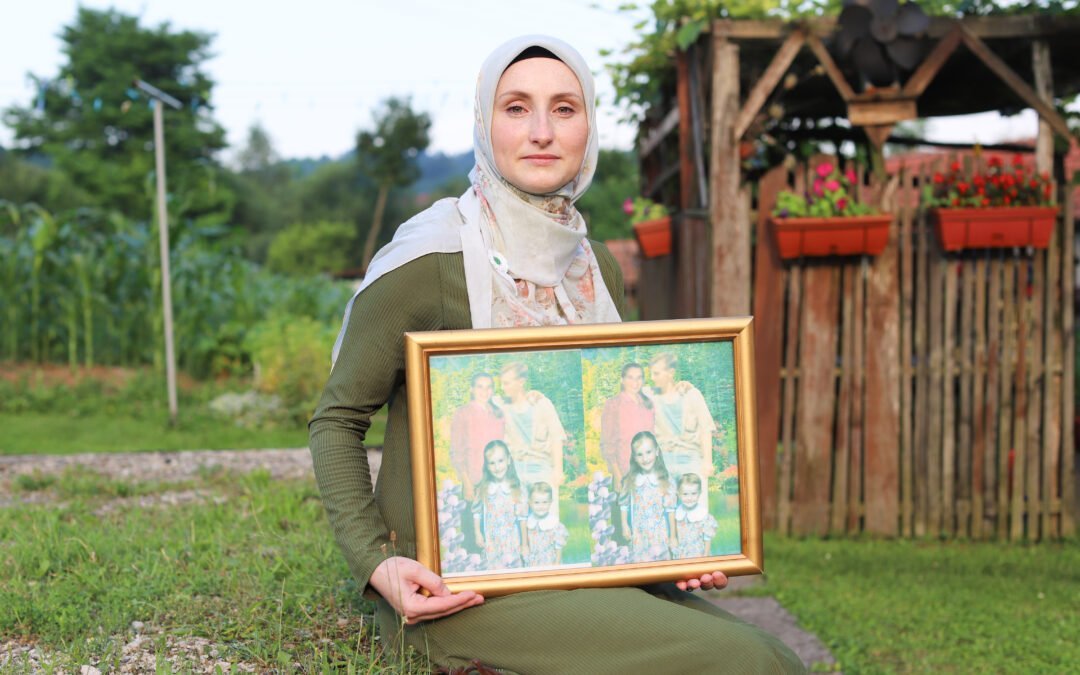
2/2 ”When we arrived at the safe territory, we lived in a school for a while. Later we moved here to Tinja. In the beginning, we lived with four other families. I started going to school for the first time. I remember seeing other children with their fathers and wondering if my father would ever come back. At school, I never said that I didn’t have a father anymore. I always kept hope, and I would tell the kids in school that he would come back one day. I remember children in school telling me that I was a liar and that my father was dead. It upset me so much that one day I went to school and told everyone my father had returned. I was so convincing that even the teacher believed me, and had to call my mom to check. We never had the chance to take a family portrait. My mother was still pregnant when she had to say goodbye to my father, so my sister never got to meet him. Originally this was a photo of my mother, my sister, and me. We added our father with photoshop so that we would have one family photo with the four of us. In 2010, we got confirmation that they had found his body. Every year, I go to his grave to say a prayer. I know it’s not rational, but to this day, I feel guilty. Sometimes I think he should have tried to escape through the woods. It was as if he wanted to spend his last moments with us.”


Recent Comments