
½ “I was never taught to share my feelings. I am an only child so whenever I would go through something I would try to talk to my parents about it. However, I never felt taken seriously by them. At the age of fifteen I got into a serious depression. For almost four years I would not leave my room. In the beginning of my depression my mother took me to see a psychologist. We had a one-hour conversation and when I was done my mum came to pick me up. It felt really good to talk to someone. The psychologist said to my mother that from now on it was important that she would speak to me about feelings and emotions. My mother interpreted it as criticism and an invasion of our family’s privacy. She never took me back to see the psychologist..’‘
(Tunis, Tunisia)
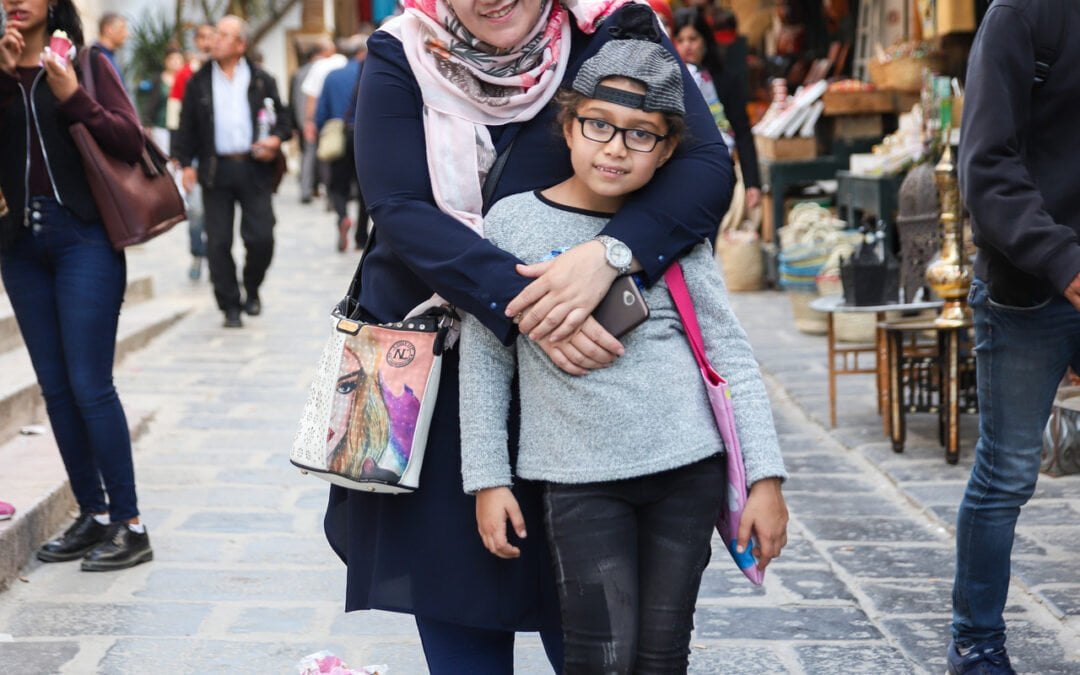
“She is a shy girl. Especially in school she had a lot of trouble making friends. That is why we helped her to find a hobby. She said she wanted to do Kung Fu so we enrolled her into a Kung Fu course. At Kung Fu she didn’t make a lot of friends but she made one really good friend. Her name is Fula and they are inseparable. Whenever we go to the mall to buy groceries and she sees a bracelet or a nice toy, she always asks: “Can I buy this for Fula?”
(Tunis, Tunisia)
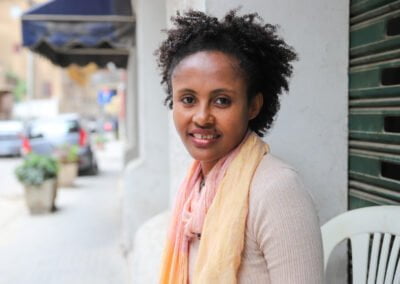
“Tunisia is not an easy place to live if you look like me. I wear my dreads with pride but it is not something that is considered normal here. Even my dad, who has always been very supportive of me, offered to pay for my tuition if I would shave off my dreads. It would be really easy for me to get rid of it and just be ’‘normal” but I wont. Many people here in Tunisia have forgotten about theirroots. In fact, many of the problems we face today have to do with our lack of identity. We speak French but we are not French. We speak Arabic but we are not Arabs. Before the French and before the Arabs we were Amazigh, the original inhabitants of North Africa. Many of us would wear our hair exactly the way I do today. It makes me sad that not only have we forgotten where we come from but we even developed prejudice against it. That is why I will keep wearing my dreads with pride even if that means facing negativity on a daily basis. My dreads represent much more than my looks, It is my way of honoring my roots’’
(Tunis, Tunisia)
“I was seven when I started writing in my diary. It was in the middle of the civil war and the basement of our building which was a clothing factory became our shelter. From my little window I could see the snipers aim and bombs falling on Beirut. I was so affected by the war that I would write down everything I saw and felt. My diary had a beautiful green cover and it became my best friend, my all time confidant. Every time I finished writing I would hide it as a treasure so no one could find it. At some point our neighborhood became a hotspot. Bombs were flying around so we had to flee. I was afraid of losing my diary so I hid it very carefully in the shelter where I was sleeping. One year later, when we returned, the building had been rebuild after all the damage of the war. The first thing I did was look for my diary but it was nowhere to be found. For many years I searched until at some point I came to realize that I would never find it again. I couldn’t write for a long time. I felt that I had lost my story. Sometimes, I still stand in front of that same building and I feel like that 7-year-old-girl again who wants to go into the shelter to try to find her diary, to find her story.”
(Beirut, Lebanon)





Recent Comments